

Blog & Technical Insights
Stay updated with the latest technological developments, industry insights, and news on Lithium Iron Phosphate (LFP) batteries and custom energy solutions.
Automated Guided Vehicle Batteries sit at the center of reliable warehouse operations. A battery can look suitable on a specification sheet yet struggle during repeated shifts, frequent charging, or cold starts. Buyers need to compare more than nominal capacity. They should examine cycle life, charging time, usable energy, thermal management, communication compatibility, and after-sales support.
Battery scientist Dr. Shirley Meng’s published work offers a useful perspective, paraphrased here: battery performance should be assessed alongside durability and operating conditions, not in isolation. That principle matters for AGVs, where a brief charging delay can leave a vehicle waiting beside a pallet lane. Small details count. Connector design, battery dimensions, and integration with the vehicle’s battery-management system can affect daily uptime.
This guide introduces leading China-based suppliers of Automated Guided Vehicle Batteries and the factors that help distinguish them. It considers product range, technical documentation, customization capability, quality controls, and service responsiveness. Supplier claims still deserve careful checking. No supplier is perfect, and a polished catalog cannot replace a sample evaluation or a clear review of test data. Teams should match battery specifications to actual routes, payloads, shift patterns, and charging windows. That work takes time. But it can prevent a costly mismatch after installation.
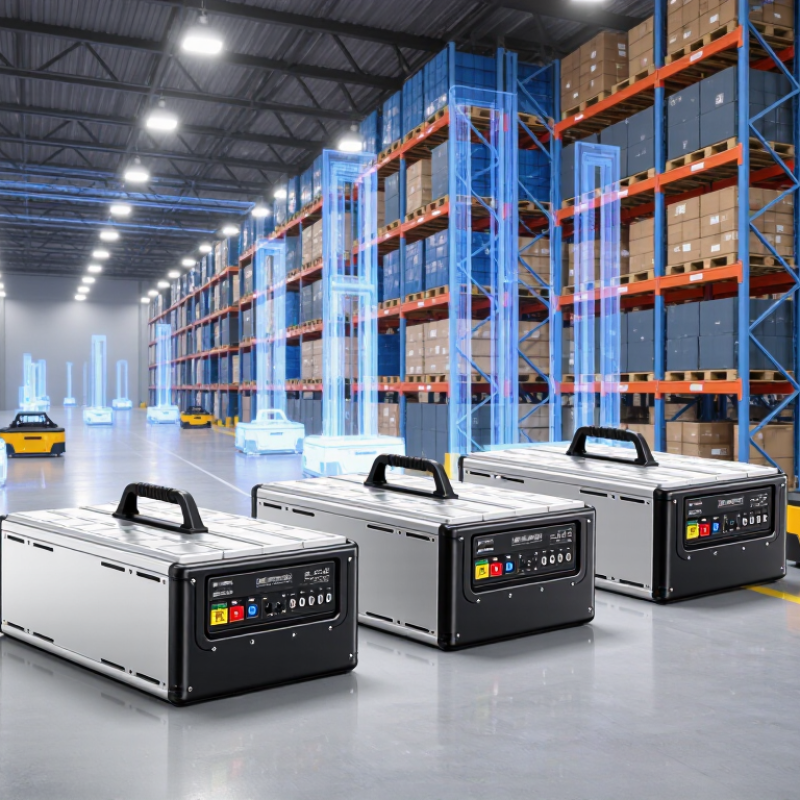
AGV Battery Fundamentals: 24–80 V Systems and Key Performance Metrics
China Top Automated Guided Vehicle Batteries Suppliers
AGV battery systems commonly operate from 24 to 80 volts. The correct voltage must match the vehicle’s drive system and charger; a mismatch can cause faults or damage. Check the equipment label and technical documents before comparing suppliers. Voltage is only one part of the specification.
Capacity, measured in amp-hours, indicates how much charge a battery can store. For practical comparison, consider usable energy in kilowatt-hours, peak discharge current, and expected operating hours per charge. An AGV lifting a heavy load may draw more current than one moving on a clear, level floor. Cycle life also matters, but published figures depend on test conditions and should not be treated as a guaranteed service life. Details can be slippery.
Tips: Ask for the test conditions behind cycle-life claims. Confirm charger compatibility, battery dimensions, connector type, and communication requirements. Check the stated operating-temperature range, too. A battery used in a cool warehouse may perform differently in a warm production area. Keep a small operating log: note charging time, shift duration, and unusual heat. Real use often exposes gaps in a neat specification sheet.
China Top Automated Guided Vehicle Batteries Suppliers - AGV Battery Fundamentals: 24–80 V Systems and Key Performance Metrics
| Category | System or Metric | Typical Values / Guidance | Practical Considerations |
|---|---|---|---|
| Voltage systems | 24 V class | Commonly 24 V lead-acid or 25.6 V nominal lithium iron phosphate (LFP, 8 cells in series) | Often used in compact vehicles and lighter-duty material handling; verify the equipment’s permitted voltage range. |
| Voltage systems | 36 V class | Commonly 36 V lead-acid or 38.4 V nominal LFP (12 cells in series) | Confirm that the charger and vehicle controller support the selected chemistry and its charging voltage. |
| Voltage systems | 48 V class | Commonly 48 V lead-acid or 51.2 V nominal LFP (16 cells in series); some designs use other series counts | A widely used industrial voltage class; check the battery’s full charge and discharge voltage limits against the vehicle specification. |
| Voltage systems | 72–80 V class | Examples include 72 V lead-acid systems and 76.8 V (24-cell) or 80 V (25-cell) nominal LFP configurations | Series count and nominal voltage vary by design. Confirm compatibility with the complete operating-voltage window, not just the nominal rating. |
| Chemistry | Lead-acid | Typically 2 V nominal per cell; flooded and valve-regulated designs are available | Requires a chemistry-matched charging profile. Flooded types require appropriate ventilation and maintenance; follow the battery maker’s instructions. |
| Chemistry | Lithium iron phosphate (LFP) | Typically 3.2 V nominal per cell; pack voltage depends on the number of cells in series | A battery management system (BMS) is normally used for cell monitoring and protection. Use a compatible charger and approved pack configuration. |
| Capacity and energy | Ampere-hours (Ah) and kilowatt-hours (kWh) | Approximate nominal energy (kWh) = nominal voltage (V) × capacity (Ah) ÷ 1,000 | For example, a 48 V, 200 Ah pack is approximately 9.6 kWh nominal. Usable energy is lower and depends on chemistry, limits, temperature, age, and load. |
| Runtime estimate | Energy-based calculation | Estimated runtime (hours) ≈ usable battery energy (kWh) ÷ average vehicle power (kW) | Treat this as an initial estimate. Route, payload, acceleration, idle time, charging opportunities, and operating temperature affect actual runtime. |
| Discharge capability | Continuous and peak current | Must meet the vehicle’s continuous demand and short-duration peak demand; values are pack-specific | Check motor-controller limits, BMS current limits, connectors, cables, and protection devices. Do not select a pack using capacity alone. |
| Charging | Charge current and charge time | Set by the battery and charger specifications; no single current or charge-time value applies to all AGV batteries | Use a charger matched to battery chemistry, pack voltage, and BMS requirements. Allow for charge taper, temperature limits, and operating schedule. |
| Cycle life | Cycles to a stated end-of-life threshold | Varies substantially by chemistry, depth of discharge, temperature, charge rate, and the manufacturer’s test method | Compare published cycle-life figures only when test conditions and end-of-life capacity criteria are stated. |
| Operating environment | Temperature and enclosure | Permitted operating and charging temperatures depend on the specific cells, pack, and BMS | Confirm the rated temperature range, ingress protection, vibration suitability, and any cold-storage or cold-charging restrictions. |
| Selection checklist | System compatibility and safety | Verify nominal and maximum voltage, capacity, current limits, dimensions, mass, connectors, communications, and applicable safety requirements | Obtain the vehicle and battery technical specifications and confirm integration with the charger, controller, and site operating procedures. |
Note: Values and configurations above are general technical references, not a specification for a particular vehicle or battery. Always follow the battery, vehicle, and charger manufacturers’ documentation.
FAQS
Many systems operate between 24 and 80 volts. Match the battery to the vehicle and charger. Check the equipment label before selecting one.
No. Also compare usable energy in kilowatt-hours, peak discharge current, and expected hours per charge. A heavy load can draw more current.
Payload, route distance, floor conditions, stops, and shift patterns all matter. A clear, level route may use less power than repeated loaded trips.
Ask which test conditions produced the figure. Treat it as an estimate, not a guaranteed service life. Real-world performance can differ.
Confirm battery dimensions, connector type, charger compatibility, and communication requirements. Small mismatches can stop a vehicle from charging properly.
A nearby charging point can support breaks between trips. But pallets blocking that point may undermine the plan. Easy to overlook.
Yes. Check the stated operating-temperature range and compare it with the site’s conditions. A cool warehouse and a warm production area may differ.
Record charging time, shift duration, and unusual heat. These notes may expose gaps between a specification sheet and daily use.
No. Reported robot installations and investment plans describe broader automation trends, not the needs of each facility. Review actual routes and workloads.
Compare usable capacity, charging time, and performance under real payloads. Track route changes and operator habits too. Runtime estimates may be optimistic.
Conclusion
Automated Guided Vehicle Batteries power the mobile systems that move materials through warehouses, factories, and logistics centers. Common AGV battery systems operate within the 24–80 V range, with performance shaped by usable capacity, energy density, charging time, cycle life, and safe operation. China’s supplier landscape includes both lithium-ion and lead-acid options, each suited to different operating patterns, budgets, and maintenance needs.
Choosing a battery means matching its specifications to the vehicle and workload. Buyers can compare cycle-life targets of roughly 2,000–5,000 cycles and assess whether the battery can support operation at up to 80% depth of discharge. Supplier evaluation should also consider charging requirements, safety provisions, warranty coverage, and compatibility with the AGV. A well-matched system can help maintain reliable vehicle availability across demanding, repeated shifts.